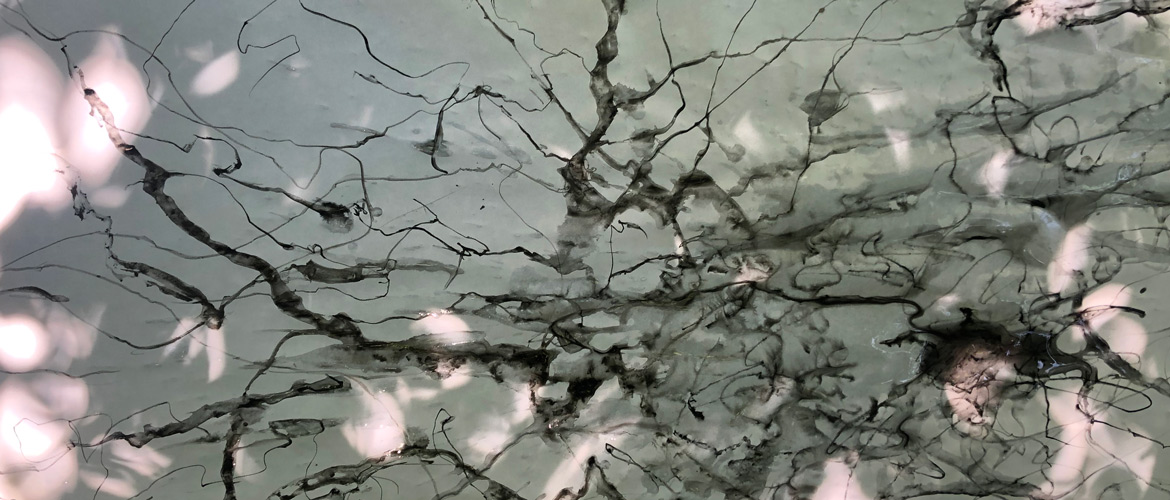
Roots at Darts Hill Garden
What Holds Us, What Connects Us?
Most of a tree is doing something we cannot see. We notice trunk, branches, leaves, bark, blossom. But beneath our feet is another story altogether. Roots reaching. Fungi threading through soil. Water and nutrients moving. Lives touching lives in ways we may walk over every day without ever noticing.
Roots grew from a collaboration with visual artist and arborist Tracie Stewart and from our shared curiosity about those hidden relationships. What might trees teach us about connection? And what happens when we begin to wonder whether a forest is less a collection of individuals and more a neighbourhood?
First, We Slow Down
Before we begin talking about roots, it helps to remember that we have some too. So we slow down. A little breathing. A little Chi Kung. Feet on the ground.We let our eyes soften and begin noticing where we actually are. The texture of bark. The smell of soil. The movement of branches overhead. A root lifting the path. A patch of moss occupying a world of its own. It is surprising how much appears when we stop hurrying past it.
And then we begin asking questions. What is happening beneath us right now? Who is connected to whom? What holds this place together?
The Forest Beneath the Forest
Tracie brings her knowledge as an arborist into the conversation, helping us look more closely at the life of trees—their roots, their relationships, and the often-hidden networks beneath the forest floor. We explore the ways roots and mycelial networks interact in the soil and how resources can move through these living systems. Suddenly the ground beneath us becomes much less empty. There is a whole unseen world of connection under our feet.
And of course, being humans, we begin wondering about ourselves. What are our underground networks?Who supports us when no one else can see? What do we share? Where do we receive nourishment? Who have we quietly helped hold up? Perhaps community has roots too.
Meeting Cedar
Western Red Cedar became one of our teachers. Rather than seeing Cedar as scenery, resource, or simply “a tree,” we were invited to meet Cedar as another being—alive, present, and part of a web of relationships that was already there long before we arrived. Indigenous teachings of kinship, reciprocity, and relationship with the living world helped open that doorway for us.
What changes when we stop looking at a tree and begin meeting one? When Cedar is no longer an it, but a fellow being with its own life, history, relationships, and way of being in the world? The questions begin to change. Who is this tree? Who lives with Cedar? Who depends on Cedar? What does Cedar give, and what does Cedar receive? What might change in us if we approached with respect, curiosity, and a willingness to listen?
We do not need to rush toward answers. Sometimes the most important shift is simply realizing that we are not the only beings here. And perhaps a better relationship begins when we meet one another that way.
Roots Become Art
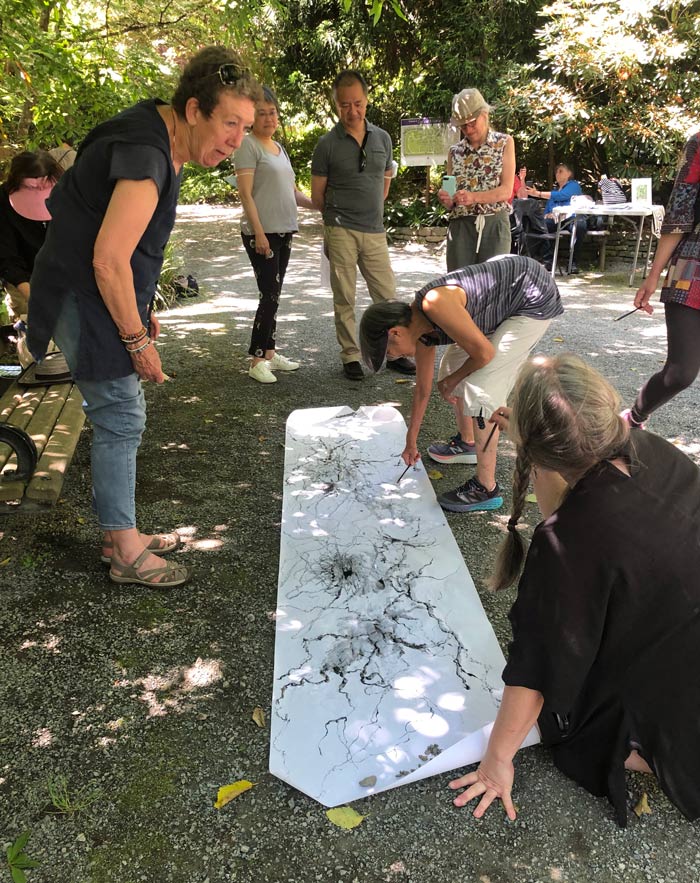
And then we make. Because this is not a lecture about trees. Participants become part of the work. Science, observation, movement, imagination, conversation, and art begin tangling together rather like—well—roots.
People respond to what they have noticed. They make marks. Add something of their own experience. Follow a line. Connect one thing to another. One person’s thought crosses another person’s drawing. A root becomes a memory. A network becomes a community. Something individual begins joining something larger.
And slowly, a collaborative artwork grows that could not have been made by any one of us alone. Which seems particularly appropriate for a workshop about roots.
What Holds Us?
I keep returning to this. A forest may look like a gathering of separate trees. A community may look like a gathering of separate people. But look a little more closely, or perhaps a little more deeply, and separation becomes harder to find.
There are relationships everywhere. Visible ones. Invisible ones. Ancient ones. New ones just beginning.
Perhaps roots offer us a lovely question to carry home: What if being strong does not mean standing alone? Perhaps it means knowing how to reach. How to receive. How to share. How to belong. And how to remember that, underneath all the things that make us appear separate, something is always reaching toward something else.